


If you have ever run a calculation for a charitable gift annuity (CGA) or a charitable remainder trust (CRT), you have seen a specific number – usually somewhere between 4% and 6% – labeled as the “IRS Discount Rate” or the “Section 7520 Rate.” (Some planned giving connoisseurs like to call it the “CMFR.”) For many of us, this is just a mysterious number that suddenly appears to determine how much of an income tax deduction our donors get.
In simple terms, the 7520 rate is the IRS’s way of saying, “If the donor kept this money and invested it themselves, this is the interest rate we assume they would earn.” But where does this Discount Rate come from, and why is it so restless?
A Brief History of Interest (and Rounding)
Before 1989, the IRS was a bit more predictable, if less accurate. It used fixed actuarial tables with a static discount rate, at first 6% and then, beginning in 1983, 10%, to value remainder gifts and life estates. This worked fine when the economy was steady, but it became wildly unrealistic during the high-inflation eras of the late 20th century. And so, Congress stepped in with the Technical and Miscellaneous Revenue Act of 1988 (TAMRA), creating Section 7520 of the Internal Revenue Code. The goal was to force the IRS to use discount rates that more closely reflected the real world.
The calculation for the 7520 rate is a bit like a Trivial Pursuit “Science & Nature” question. Every month, the Treasury Department looks at the average market yield on outstanding marketable obligations of the U.S. (basically, government bonds) with maturities of three to nine years. This is known as the “Applicable Federal Mid-Term Rate.” The IRS then takes 120% of that rate and rounds the result to the nearest two-tenths of one percent. Presto: we have the “IRS Discount Rate of the Month.”
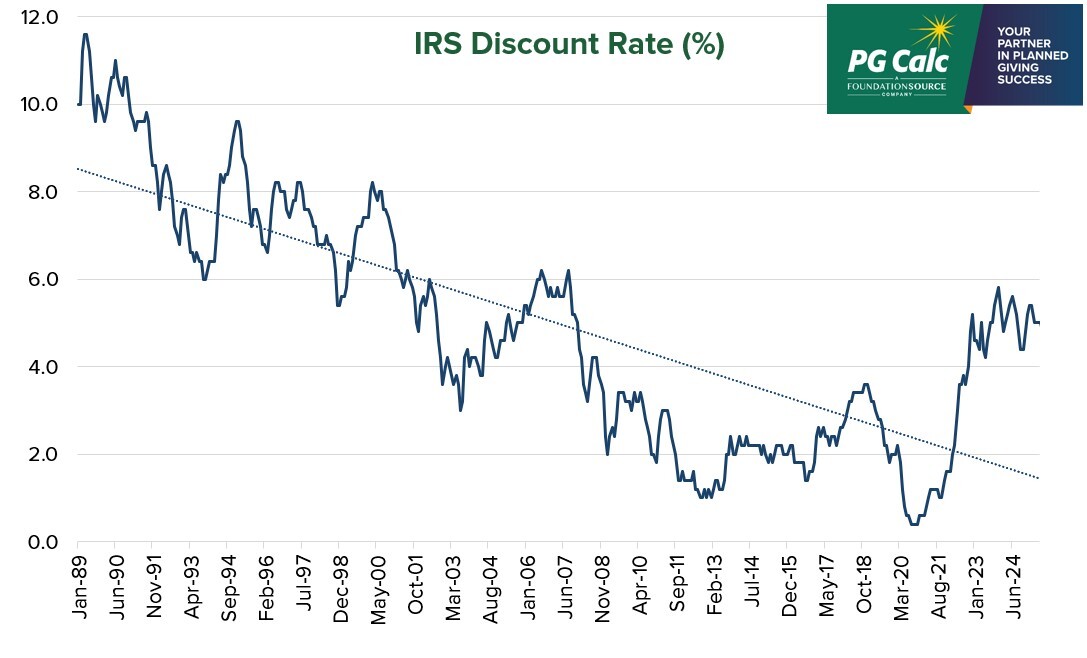
Historically, the IRS Discount Rate has averaged 5%, but it’s been a roller coaster. In the spring of 1989, the rate was a staggering 11.6%. By contrast, during the global pandemic in the fall of 2020, it bottomed out at an all-time low of 0.4%.
CMFR History Since 1989
Whatever Rate Works for Your Donor
When it comes to planned gifts, the 7520 Rate is the lever that moves the donor’s charitable deduction. A higher rate is generally “better” – provides a larger deduction – for gifts where the charity gets the money at the end (like a charitable remainder trust or a gift annuity). This is because a higher discount rate makes the value of the donor’s future income stream look “smaller” in today’s dollars, which leaves a “larger” remainder for the charity – and thus a larger charitable deduction for the donor.
And there’s a secret weapon for gift planners: the “Two-Month Lookback.” Under Section 7520, the donor can choose the rate for the month the gift is made, or the rate from either of the two preceding months, which ever produces the best result for them.
Four Rules of Thumb:
-
Check the Trend: If rates are rising, the current month’s rate is likely the best choice for a CGA or CRT. If they are falling, the “lookback” to a previous month will yield a higher deduction.
-
Run a Comparison: Use PGM Anywhere to calculate the deduction using all three available rates. Even a 0.4% difference in the rate can translate into thousands of dollars in extra deduction for a significant gift.*
-
Watch out for Gift Annuities: Although the highest rate produces the largest charitable deduction, it also results in lower tax-free income from a CGA. You can be a real hero if your donor doesn’t itemize or is willing to sacrifice a little charitable deduction in return for more tax-free income.
-
Mind the Retained Life Estates and Lead Trusts: If you are working on a retained life estate or a charitable lead trust, the math flips the logic. For these gifts, a lower 7520 rate is usually the donor’s best friend.
While the 7520 Rate doesn’t have a thing to do with how the gift actually performs in the stock market, it is the gatekeeper for the tax benefits at the start. Knowing how to pick the right rate is the difference between a smart gift and a “dumb” mistake.
* It’s worth pointing out: the IRS discount rate has a much greater effect on the deduction for annuity gifts (CGAs, charitable remainder annuity trusts, charitable lead annuity trusts) than unitrust gifts (charitable remainder unitrusts, charitable lead unitrusts) … but the reason is a subject for another BDQ.
|
The BDQ (Big Dumb Question) We’ve all been there: at some point during a presentation someone says, “This may be a dumb question, but…” and the presenter (hopefully in a gracious tone of voice) says, “There’s no such thing as a dumb question,” before providing the obvious answer. But sometimes, just to yourself, you have to admit you were wondering about the same thing. That’s the idea behind this occasional series we’re calling “The Big Dumb Question” (or BDQ). Our aim is to provide easy to understand answers to basic gift planning questions – the kinds of questions you may be reluctant to ask. We’ve got a list of topics in mind (see below). More Big Dumb Questions Here are some of the BDQs we have addressed or plan to:
If there are other BDQs you’d like answered, let us know. You can remain anonymous, of course! |